How to Make LinkedIn Content Easier: Stop Reinventing the Wheel
 15-minute-guy Leeds
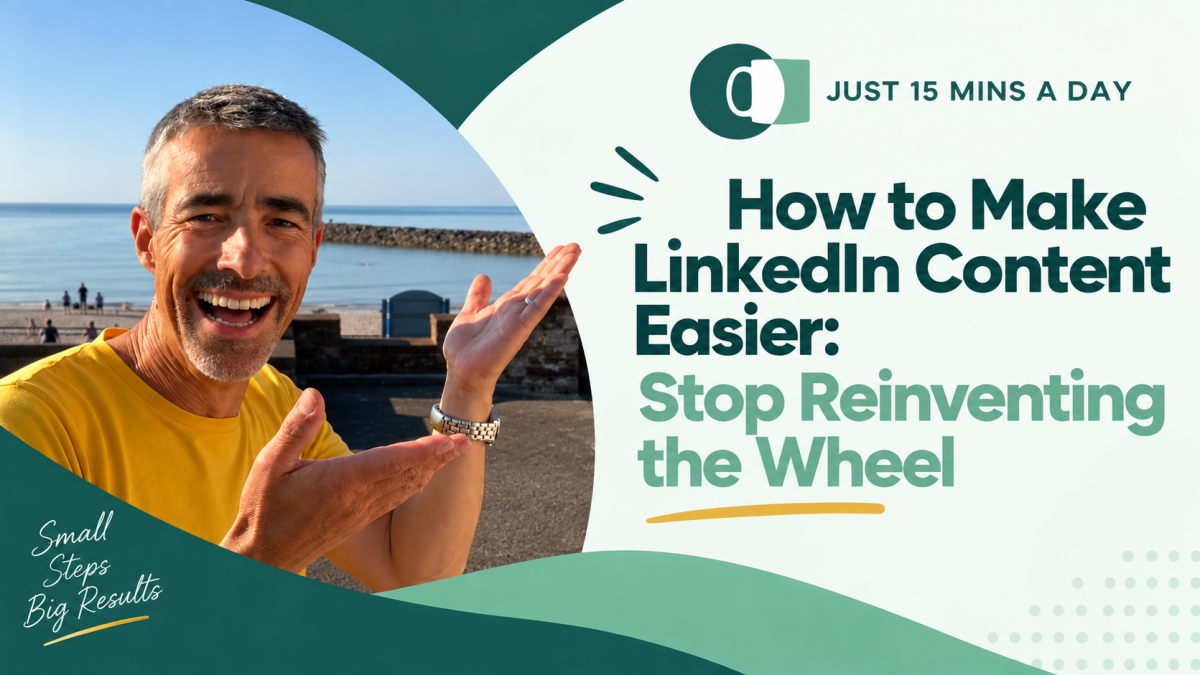
Discover how to make LinkedIn content easier by using real-life experiences, repeatable ideas and simple 15-minute habits.
How to Make LinkedIn Content Easier: Stop Reinventing the Wheel
Coming up with LinkedIn content can feel like a full-time job.
What am I going to post today?
What should I talk about?
Have I already said this?
Do I need a new idea?
And then you look at somebody else's LinkedIn feed and wonder how they seem to have an endless supply of things to say.
Here's the thing.
You probably don't need more ideas.
You probably need a simpler way of using the ideas you already have.
Because a lot of the best content is already happening around you.
You just need to notice it.
Your real life is full of content
I was reminded of this during a particularly busy week.
I spent time at Accountex in Manchester and then at a DFK International event in Liverpool.
There were conversations.
Travel.
People I hadn't seen for a while.
New people I met for the first time.
A video panel.
A few nerves.
And, at one point, the very real possibility of losing my voice.
All of that became content.
Not because I sat down and thought:
"Right. What clever LinkedIn content can I manufacture today?"
It was simply what was happening.
And that is an important distinction.
You don't always need to create something for LinkedIn.
Sometimes you just need to notice something.
Don't start with "I'm at an event"
If you're at an event, the obvious LinkedIn post is usually:
I'm at [event].
Then you add a photograph.
Maybe tag a few people.
And that's it.
There's nothing wrong with that.
But everyone else at the event is doing roughly the same thing.
During my week at Accountex, I took a different approach.
I asked:
That was relevant to me because I was going to spend the day talking to accountants and bookkeepers and then hosting a video panel.
So I talked about something very ordinary:
Hydration.
Soothing sweets.
Honey and ginger tea.
And the worry of losing my voice.
Then I brought the story around to the event.
That post reached 949 impressions and generated 46 comments, compared with 333, 391 and 328 impressions for the three posts immediately before it.
I'm not suggesting that asking about losing your voice is some secret LinkedIn formula.
It isn't.
The point is that I started with a human problem, rather than an event announcement.
And that gave people something they could relate to.
People had experiences of losing their voice.
People had opinions.
People had advice.
So they joined the conversation.
That's what good content can do.
One subject can give you five posts
Another trap we fall into is thinking every post needs to be about a completely different subject.
It doesn't.
In fact, repeating a subject can be useful.
One of my videos that week came from a LinkedIn Live conversation about AI and video.
The basic idea was that, as more AI-generated content appears online, there can be even more value in showing up as an actual human being.
You can see someone.
Hear them.
Get a feel for them.
A couple of days later, I used another clip from the same conversation.
This time, the subject was the fear of making videos.
Same broad area.
Different question.
Different angle.
Different piece of content.
And that's something you can use immediately.
Take one subject you're known for.
Then ask yourself:
What is the biggest question people have about it?
What are they worried about?
What mistake do they commonly make?
What would I do differently?
What's a simple example from real life?
There's five pieces of content.
You didn't need five completely new ideas.
You just needed five ways into the same idea.
You don't have to make everything from scratch
There's another useful lesson here.
The video I shared wasn't created specifically for that LinkedIn post.
It came from a conversation I'd already had.
Someone had taken the longer recording and turned it into shorter clips.
One conversation became several pieces of content.
That's worth remembering.
If you've ever:
Hosted a webinar
Recorded a podcast
Done a LinkedIn Live
Given a presentation
Had a useful client conversation
Been interviewed
Answered a question repeatedly
…you may already have more content than you think.
Go back through it.
There might be a useful answer hidden in there.
A good question.
A story.
A mistake.
A point you made in passing.
You don't always need to create another thing.
Sometimes you need to reuse the thing you've already created.
Real life makes better content than you think
One of my other posts that week was about feeling nervous and excited before going to Liverpool for my first in-person event with DFK International.
There wasn't a grand strategy behind it.
I was nervous.
I was excited.
And it got me thinking about how similar those feelings can be.
That was enough.
The photograph wasn't perfectly staged either.
It was simply a photograph of me.
And that's okay.
Your content doesn't always need to look like a marketing campaign.
Sometimes a real photograph and a real observation are more useful.
The same thing happened with my Friday gratitude post.
I looked back over the week.
I thought about what had happened and the people I'd spent time with.
Then I wrote about it.
That post was actually the best performer of the week for impressions, with 1,546.
But I didn't create it because I thought:
"This is going to get 1,500 impressions."
I created it because I do it every Friday.
That's an important difference.
Repeatable content makes LinkedIn easier
This is probably the biggest lesson from the week.
I have things I do regularly.
Monday video.
Sunday newsletter.
Friday gratitude.
The names aren't important.
The repeatability is.
Because when you've got a repeatable format, you don't start every morning with:
What on earth am I going to post today?
Some of the decision has already been made.
And that makes creating content much easier.
You could have:
Motivational Monday
Tax Tip Tuesday
Workout Wednesday
Throwback Thursday
Feel Good Friday
Or something completely different.
It doesn't matter what you call it.
Start with one repeatable idea.
Do it regularly.
See what happens.
Then, if it helps, add another.
You are building a habit rather than relying on inspiration.
Your content doesn't have to be clever
This is probably the bit I want you to remember most.
The posts that performed best for me that week weren't particularly clever.
I lost my voice.
I went to some events.
I felt nervous.
I had a good week.
I talked about people.
Real life.
Real experiences.
Real conversations.
That's content.
You don't need to turn yourself into a content machine.
You need to get better at noticing what's already happening around you.
Think about LinkedIn as a networking event you can attend every day.
At a networking event, you don't walk around delivering polished presentations to everyone you meet.
You talk.
You ask questions.
You tell stories.
You listen.
You find things you have in common.
You get to know people.
Your LinkedIn content can work in exactly the same way.
Try this 15-minute content exercise
If you're staring at a blank LinkedIn screen, don't try to come up with the perfect post.
Give yourself 15 minutes instead.
Spend 5 minutes looking backwards
Think about the last few days.
What happened?
Who did you speak to?
What surprised you?
What went wrong?
What made you laugh?
What did somebody ask you?
What are you looking forward to?
Write down five things.
Spend 5 minutes choosing one
Pick the thing that makes you think:
"There's probably something in that."
Then ask:
What's the bigger question here?
Or:
What might somebody else recognise in this?
Spend 5 minutes writing
Start with the most interesting part.
Not the company announcement.
Not the event name.
Not the polished conclusion.
Start with the thing that might make another person stop and think:
"Oh yes. I've had that happen."
Then tell the story.
Ask a question if there's a natural one.
And publish it.
It doesn't need to be perfect.
It just needs to be real and useful.
You don't need endless content ideas
If LinkedIn feels difficult because you think you need a brand-new idea every day, take the pressure off yourself.
You don't.
Find one subject you care about.
Find five questions around it.
Look at what's happening in your actual life and work.
Reuse good conversations.
Create a couple of repeatable formats.
And pay attention to the people around you.
There is probably far more content there than you realise.
You just have to notice it.
You don't need to become a content machine.
You just need to keep showing people something useful, interesting or human.
And you can do a lot of that in 15 minutes.
The 15-minute takeaway
Open your diary or calendar.
Look back over the last week.
Write down five things that happened.
Choose one.
Ask yourself:
What's the bigger question or lesson here?
Then write a short LinkedIn post about it.
No complicated content strategy.
No staring at a blank screen for an hour.
Just start with what's already happening.
Keep showing up.
And see what the conversation becomes.
Want some help making LinkedIn simpler?
My LinkedIn Accelerator is designed to help you become more visible on LinkedIn without spending hours online.
LinkedIn AcceleratorCategories: : Content Ideas